European Space agency (ESA) are having trouble pin pointing a re entry location of the wayward satellite.
A lack of the predicted solar wind whick thickens the atmosphere did not eventuate.
There is a lot to be read between the lines in this piece by ESA
Picked up this article via Jo Nova
http://joannenova.com.au/2018/03/satellite-going-awol-at-28000kmhr-tracking-that-chinese-stray/
Basically the upper atmosphere density is changing. The sun controls the density of our atmosphere. Also commonly known as Satellite drag and drift
The ESA site
http://blogs.esa.int/rocketscience/2018/03/26/tiangong-1-reentry-updates/
Tiangong-1 reentry updates
Latest reentry forecast provided by ESA’s Space Debris Office, ESOC, Darmstadt, Germany.
Latest reentry forecast provided by ESA’s Space Debris Office, ESOC, Darmstadt, Germany.
Update 30 March 2018
The current estimated reentry window runs from the night of 31 March to the late evening of 1 April (in UTC time); this is highly variable.
Today’s new forecast is a noticeable change from that of yesterday, and is due to solar activity.
One of the main reasons why it is so difficult to make an accurate reentry predictions, even if just a few days in advance of an expected reentry, materialised during the last 24 hours.
A high-speed stream of particles from the Sun, which was expected to reach Earth and influence our planet’s geomagnetic field, did, in fact, not have any effect, and calmer space weather around Earth and its atmosphere is now expected in the coming days.
This means that the density of the upper atmosphere, through which Tiangong-1 is moving, did not increase as predicted (which would have dragged the spacecraft down sooner) and hence the ESA Space Debris Office has adjusted the predicted decay rate.
This implies that the new (and still uncertain) reentry window has shifted to later in the day on 1 April.
Reentry will take place anywhere between 43ºN and 43ºS (see map here). Areas above or below these latitudes can be excluded. At no time will a precise time/location prediction from ESA be possible. This forecast was updated approximately weekly through to mid-March, and is now being updated every day.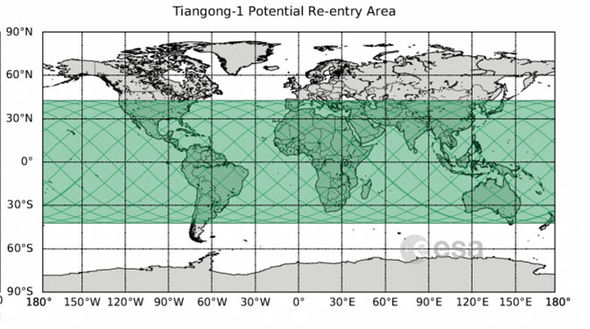
Incoming satellite, Put on your hard hat.
-
Top Stories



You’re viewing a single post only. To view the entire thread just sign in or Join Now (FREE)

