Posted on 12:42 pm, March 30, 2018 by Alan Moran from Quadrant
"The fall from grace of the Australian electricity industry has been breathtaking. At the turn of the century, Australia had perhaps the world’s lowest-cost, most competitive electricity industry. This rested on cheap, low-sulphur coal, which was responsible for 85% of generation, ample supplies of gas, and modest but useful hydro-electricity generation capacity.
Reform in the 1990s harnessed these assets to create a low cost, highly reliable system. The reforms included:
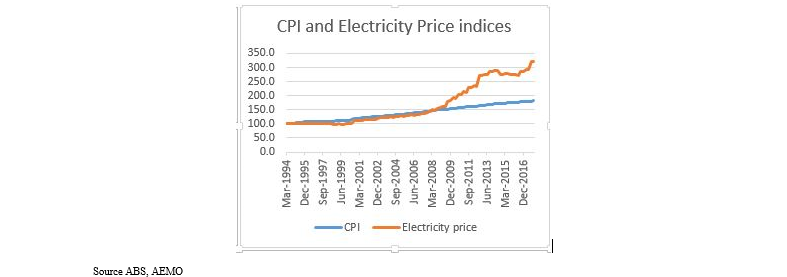
Seventeen years later the low-cost market-based system had collapsed. Electricity price increases, having risen somewhat less than the Consumer Price Index, started to surge after 2008.
- a national electricity system that required competitive provision of generation and retailing through a spot market and power contracts,
- privatisation of most of the industry, and
- disciplined pricing of the monopoly networks.
This outcome was due to political intervention in different aspects of supply, including banning gas exploration and raising coal royalties. But above all else, to the adoption of carbon-abatement measures. Those measures briefly included a carbon tax, but their fundamental drivers were increased obligations upon retailers for increasing levels of wind and solar energy under a Renewable Energy Target (RET) for “large scale” mainly wind facilities, and through direct subsidies.
Those supportive of renewables argue that energy subsidies are simply a bridge to an inevitable triumph of that technology. Over the past 40 years there have been endless forecasts that wind/solar will soon be cheaper than fossil fuel generated electricity. With good reason, those publicising such forecasts never argue for the corollary: an abandonment of subsidies.
For Australia, wind costs are at least $100 per MWh – contracts signed at less than this include the RET subsidy (the forward price of which is $50 per MWh). Solar and batteries are even more expensive, though batteries will likely have a role in providing ancillary services in a renewable system. Coal-based generation with existing plant can be profitable at well under $40 per MWh — although, as discussed, not once refurbishment becomes necessary. Some studies estimate new coal based investment in Australia requires a price exceeding $75 per MWh though studies by The Minerals Council of Australia estimated that a High Efficiency Low Emission plant would be economic at under $50 per MWh and experimental work involving gasification put the costs even lower.
All this said, the ultimate test is that of the market and the way to explore this is to allow markets to operate without government subsidies and other interferences, just as they did in Australia 15 years ago. This will provide the most efficient mix of generation."
Expensive Uselessness of Current Renewables
-
Top Stories










You’re viewing a single post only. To view the entire thread just sign in or Join Now (FREE)

