
Maybe it is coming? who knows for sure, 15 years ? maybe it is more?
They will have to build one first to prove what they have is viable? how many and at what cost will be the question be after that? but the other side of the coin is this? will they then close down all existing reactors, will they just bury all of the spent fuel/waste which still has 95% usable energy still in it? and move towards this new technology? Yucca Mountain certainly is no where near big enough to store all of the waste?
What we are really talking about is usable energy with existing infrastructure and at what cost for using it? or just burying it and using new infrastructure? sure this new technology will come, no doubt in my mind whatsoever that it will, but it will be gradual IMHO, there will be a changeover period, it won't just happen overnight, so in my opinion we may have 30 to 40 years up our sleeve?
https://www.theguardian.com/environ...on-brink-of-being-realised-say-mit-scientists
Nuclear fusion on brink of being realised, say MIT scientists
Carbon-free fusion power could be ‘on the grid in 15 years’
Hannah Devlin Science correspondent
@hannahdev
Fri 9 Mar 2018 16.01 AEDT Last modified on Fri 9 Mar 2018 20.45 AEDT
Shares
15k
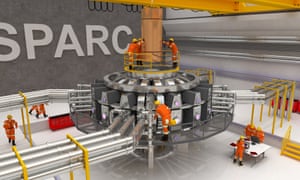
A visualisation of MIT’s planned fusion experiment. Photograph: Ken Filar/MIT
The dream of nuclear fusion is on the brink of being realised, according to a major new US initiative that says it will put fusion power on the grid within 15 years.
The project, a collaboration between scientists at MIT and a private company, will take a radically different approach to other efforts to transform fusion from an expensive science experiment into a viable commercial energy source. The team intend to use a new class of high-temperature superconductors they predict will allow them to create the world’s first fusion reactor that produces more energy than needs to be put in to get the fusion reaction going.
Bob Mumgaard, CEO of the private company Commonwealth Fusion Systems, which has attracted $50 million in support of this effort from the Italian energy company Eni, said: “The aspiration is to have a working power plant in time to combat climate change. We think we have the science, speed and scale to put carbon-free fusion power on the grid in 15 years.”
Quick guide
What is fusion?
Sign up to the Green Light email to get the planet's most important stories
Read more
The promise of fusion is huge: it represents a zero-carbon, combustion-free source of energy. The problem is that until now every fusion experiment has operated on an energy deficit, making it useless as a form of electricity generation. Decades of disappointment in the field has led to the joke that fusion is the energy of the future – and always will be.
The just-over-the-horizon timeframe normally cited is 30 years, but the MIT team believe they can halve this by using new superconducting materials to produce ultra-powerful magnets, one of the main components of a fusion reactor.
Prof Howard Wilson, a plasma physicist at York University who works on different fusion projects, said: “The exciting part of this is the high-field magnets.”
Fusion works on the basic concept of forging lighter elements together to form heavier ones. When hydrogen atoms are squeezed hard enough, they fuse together to make helium, liberating vast amounts of energy in the process.
However, this process produces net energy only at extreme temperatures of hundreds of millions of degrees celsius – hotter than the centre of the sun and far too hot for any solid material to withstand.
To get around this, scientists use powerful magnetic fields to hold in place the hot plasma – a gaseous soup of subatomic particles – to stop it from coming into contact with any part of the doughnut-shaped chamber.
A newly available superconducting material – a steel tape coated with a compound called yttrium-barium-copper oxide, or YBCO – has allowed scientists to produce smaller, more powerful magnets. And this potentially reduces the amount of energy that needs to be put in to get the fusion reaction off the ground.
“The higher the magnetic field, the more compactly you can squeeze that fuel,” said Wilson.
The planned fusion experiment, called Sparc, is set to be far smaller – about 1/65th of the volume – than that of the International Thermonuclear Experimental Reactor project, an international collaboration currently being constructed in France.
The experimental reactor is designed to produce about 100MW of heat. While it will not turn that heat into electricity, it will produce, in pulses of about 10 seconds, as much power as is used by a small city. The scientists anticipate the output would be more than twice the power used to heat the plasma, achieving the ultimate technical milestone: positive net energy from fusion.
Prof Wilson was also cautious about the timeframe, saying that while the project was exciting he couldn’t see how it would achieve its goal of putting energy on the grid within 15 years.
Unlike with fossil fuels, or nuclear fuel like uranium used in fission reactions, there will never be a shortage of hydrogen.
The reaction also does not create greenhouse gases or produce hazardous radioactive waste of the sort made by conventional nuclear fission reactors.
Prof Maria Zuber, MIT’s vice-president for research, said that the development could represent a major advance in tackling climate change. “At the heart of today’s news is a big idea - a credible, viable plan to achieve net positive energy for fusion,” she said.
“If we succeed, the world’s energy systems will be transformed. We’re extremely excited about this.”
Maybe it is coming? who knows for sure, 15 years ? maybe it is...








Add to My Watchlist
What is My Watchlist?


